1/4-20 tap drill size
A 1/4-20 tap takes a #7 drill, 0.201" (5.11 mm), and the fine 1/4-28 thread takes a #3.
Thread you're tapping
The coarse and the fine 1/4" thread.
Drill this for the tap
Available on Amazon
As an Amazon Associate, What Drill Bit earns from qualifying purchases.
Drill choices for a 1/4-20 tap
| Drill | Size | Champion’s probable thread | OSG’s formula |
|---|---|---|---|
| #9 | 0.196"4.98 mm | 77% | 83% |
| #7 | 0.201"5.11 mm | 70% | 75% |
| 13/64" | 0.2031"5.16 mm | 66% | 72% |
Fastenal’s chart and OSG’s 75% thread size (0.2013") both point to the #7.
A bigger drill leaves less thread for the tap to cut, so the tap has less work and lasts longer. OSG’s advice is the largest drill that still leaves enough thread, and it puts enough at 55% to 65% for most jobs. Champion’s probable figures run lower than the formula’s for the same drill.
Tap drill or clearance hole
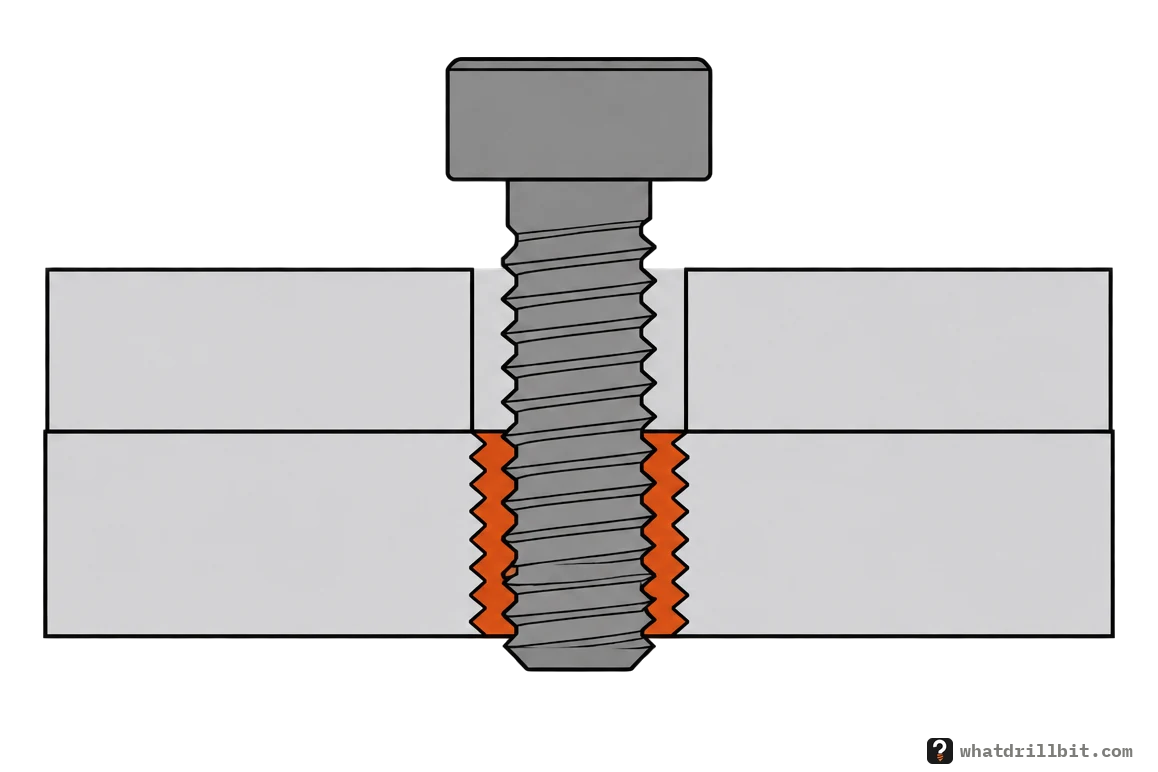
1/4 inch tap drills and clearance holes
1/4 inch tap drill and clearance holes
| Thread | Tap drill | Clearance, close | Clearance, normal |
|---|---|---|---|
| 1/4-20UNC | #70.201" · 5.11 mm | F0.257" | 17/64"0.2656" |
| 1/4-28UNF | #30.213" · 5.41 mm | F0.257" | 17/64"0.2656" |
whatdrillbit.com
Clearance hole for a 1/4 inch bolt
| Fit | Hole |
|---|---|
| Close | 0.266"6.76 mm |
| Normal | 0.281"7.14 mm |
| Loose | 0.297"7.54 mm |
Albany County Fasteners’ close and normal drills are smaller, F (0.257") and 17/64" (0.2656").
1/4-20 next to M6
A 1/4" thread is 6.35 mm across, and 20 threads per inch puts them 1.27 mm apart. An M6 x 1.0 thread is 6 mm across with 1.0 mm between threads, and its tap takes a 5 mm drill.
Champion lists a #9 drill for both: 77% thread in a 1/4-20 hole and 71% in an M6 x 1.0 hole.
Before you drill
Wear safety glasses when you drill and tap metal, and try the drill and tap on scrap of the same metal first.
Common questions
Can I use a 5.5 mm drill for a 1/4-28 tap?
Yes. Champion's chart lists a 5.50 mm drill for 1/4-28 at 67% probable thread, after the #3 (0.213").
Can I use a 13/64 drill for a 1/4-20 tap?
Yes. Champion's chart lists a 13/64" drill (0.2031") for 1/4-20 and puts its probable thread at 66%, which OSG's chart counts as enough for most jobs.
How big is a #7 drill bit in mm?
A #7 bit is 5.11 mm (0.201"). The nearest metric bit, 5.1 mm, is 0.2008".
Where we get our information from
Each thread’s drill is the cutting-tap drill on Fastenal’s tap and drill chart, checked against Champion Cutting Tool’s chart and OSG’s class 2B minor diameter limits; a 10-24 takes Champion’s #25 where Fastenal lists a #26. Champion’s other drills and their probable thread are from its own chart. Percent of thread in the answer is OSG’s formula. Clearance holes are Albany County Fasteners’ close and normal fit drills, and the ASME B18.2.8 holes are J&E Supply’s table. Millimetres are the decimal inch × 25.4. Checked against published data from OSG USA, Fastenal, Champion Cutting Tool, Albany County Fasteners and J & E Supply & Fastener Co.
See all 5 sources
- OSG USA, Tap Drill Sizes and Pitch Diameter Limits chart, Vol 3 (2024)
- Fastenal, Metalworking Decimal Equivalents Chart with tap/drill recommendations (poster 9701309)
- Champion Cutting Tool, Tap & Drill Chart (tap drill sizes with probable percent of thread)
- Albany County Fasteners, Clearance Hole Chart: close, normal and loose fit (fastener supplier's chart)
- J & E Supply & Fastener Co., Bolt Clearance Hole Chart (ASME B18.2.8) (fastener supplier's table)
Tap drill sizes are general guidance for cutting taps in common metals. The right size can change with the material, the tap and the thread class, so check the tap maker's chart for critical work.